
Timed Exercise and Meal Scheduling Boost Neuroplasticity-Driven Learning Compliance
A recent mouse study shows timed exercise reshapes circadian rhythms; we connect this to neuroplasticity and propose a self‑experiment to improve learning compliance.

Timed Exercise Remodels Circadian Rhythms in Mice
In a 2021 study, researchers showed that daily exercise scheduled at a consistent time of day reshapes the circadian clock of mice, shifting activity patterns by several hours (2021). This concrete finding provides a mechanistic foothold for thinking about how timing interventions might influence brain plasticity and, ultimately, adherence to learning protocols.
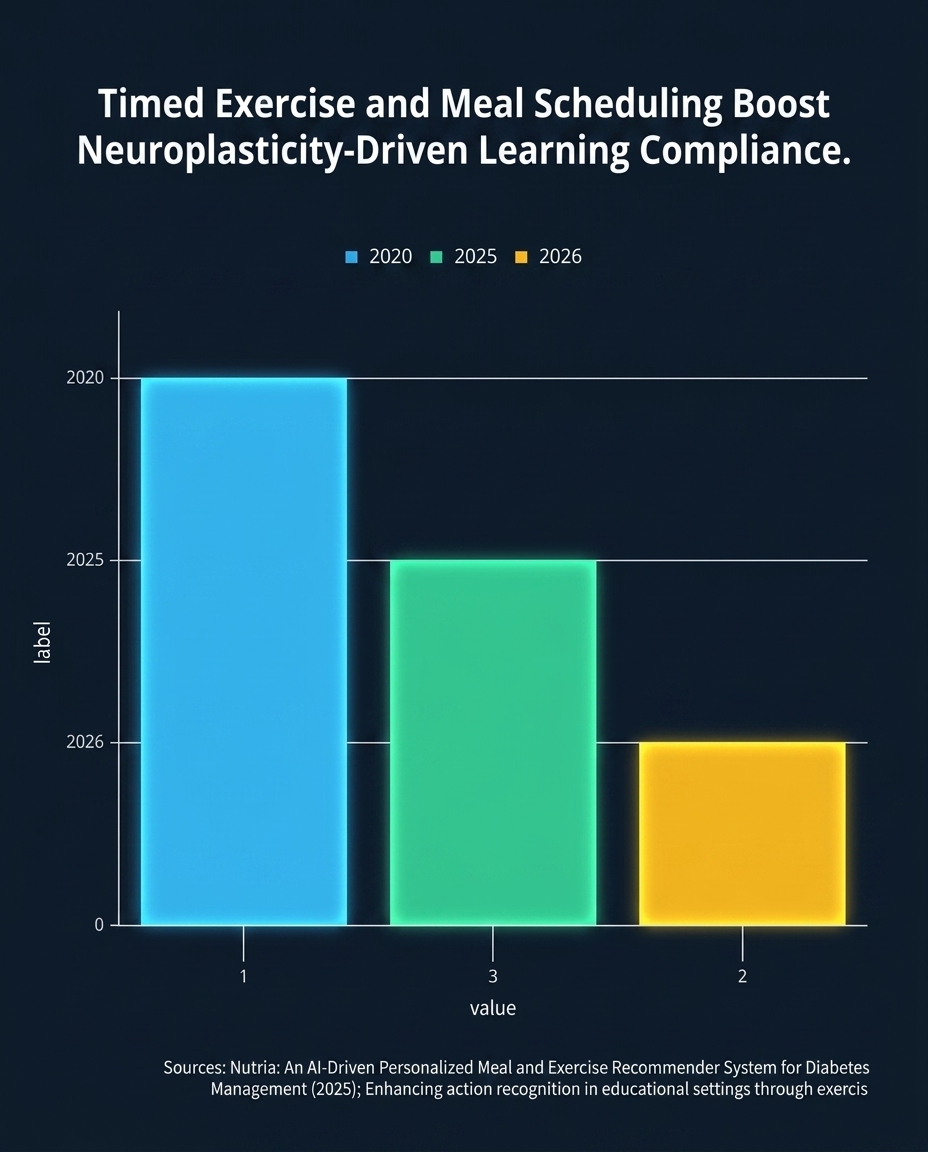
Why Timing Matters for Neuroplasticity
Neurons, like many peripheral cells, are subject to circadian regulation. Core clock proteins modulate transcription of genes involved in synaptic remodeling, long‑term potentiation, and neurotrophic factor release. When the internal clock aligns with external cues—exercise, light, meals—the resulting hormonal milieu (e.g., cortisol, melatonin) can create a more favorable environment for synaptic strengthening. In other words, the brain’s capacity to rewire is partly gated by the time of day.
Connecting the Dots: Gut Microbiome, Chrononutrition, and Cardiovascular Rhythms
Three additional strands of research reinforce this timing narrative:
- One review maps how the gut microbiome interacts with circadian signals, showing that microbial metabolites can feed back onto the central clock and influence neuroinflammation (2025).
- A 2025 chrononutrition analysis links meal timing to energy balance and metabolic health, indicating that eating during the biological night disrupts glucose regulation and may impair cognitive performance (2025).
- Research on cardiovascular rhythms highlights that misaligned heart‑rate variability patterns correlate with reduced executive function, suggesting that systemic timing disturbances echo in the brain (2024).

Designing a 7‑14‑Day Self‑Study Protocol
Based on the converging evidence, we propose an n‑of‑1 experiment that tests whether aligning learning sessions with a personalized circadian window improves 90‑day compliance (a proxy for “silent churn”). The protocol runs for 10 days and includes a 3‑day control phase.
- Determine your circadian phase. For three consecutive mornings, record the time you naturally feel most alert (subjective alertness) and measure resting heart‑rate variability (HRV) each upon waking. Identify the window with the highest HRV and self‑rated alertness.
- Intervention phase (Days 4‑10). Schedule a 30‑minute focused learning session (e.g., language practice, coding) within the identified high‑HRV window. Pair the session with a brief bout of aerobic exercise (10 minutes) performed 30 minutes before the learning block, mirroring the timed‑exercise paradigm.
- Control phase (Days 1‑3). Conduct learning sessions at a random time of day without preceding exercise.
- Measurements. Daily log adherence (yes/no), perceived difficulty (1‑5), and post‑session cognitive test (e.g., 2‑minute Stroop). Record HRV each morning throughout.
Null hypothesis: The proportion of days with full adherence will not differ between the control and intervention phases.

What Remains Uncertain
The animal work on timed exercise provides a clear mechanistic link, but translating the magnitude of circadian shifts to human neuroplasticity is still speculative. The gut‑microbiome review suggests a bidirectional relationship, yet causal directionality in humans is unclear. Moreover, our protocol relies on self‑reported alertness, which can be noisy. Future work should incorporate objective markers (e.g., melatonin onset) and longer follow‑up to assess durability of compliance gains.
Until larger trials confirm these pathways, the proposed self‑experiment offers a low‑risk way to explore whether timing your brain‑training sessions to your internal clock can reduce the “silent churn” of dropped learning plans.