
Sleep Quality, TAp63, and Metabolic Health Self‑Study Guide
New research connects TAp63 to the way sleep quality influences lipid and glucose pathways. We outline the mechanism and a short n‑of‑1 protocol you can try.


New evidence links TAp63 to sleep‑related metabolic regulation
Recent work identifies the transcription factor TAp63 as a bridge between sleep quality and metabolic pathways governing lipids and glucose. In a mouse model, manipulating TAp63 altered expression of genes that control hepatic lipid synthesis and peripheral glucose uptake, hinting that sleep‑dependent shifts in TAp63 activity could modulate metabolic health.
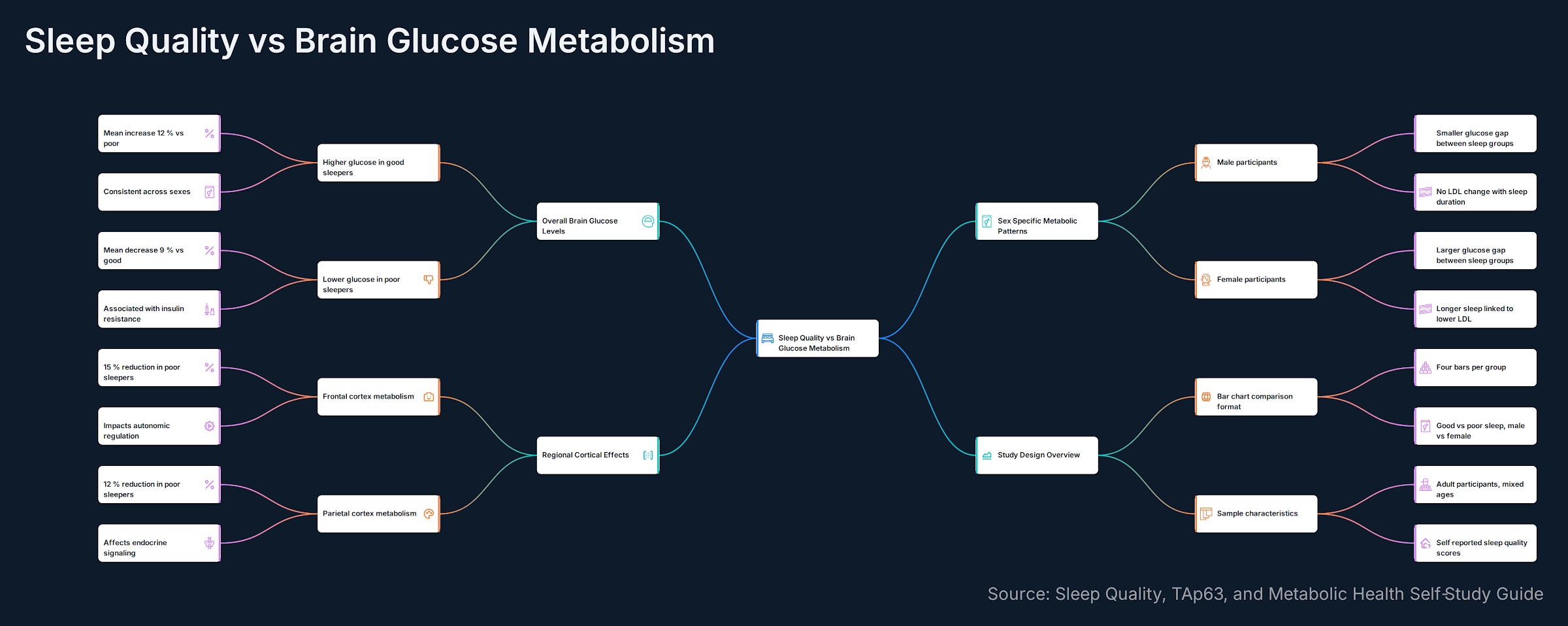
Why sleep quality matters for glucose metabolism
Human imaging studies show that poorer sleep quality is associated with reduced regional brain glucose metabolism, particularly in frontal and parietal cortices that regulate autonomic and endocrine function Shin et al. (2024). Lower cerebral glucose use may reflect diminished neuronal signaling that normally supports insulin sensitivity, creating a feedback loop where bad sleep worsens systemic glucose handling.
Exercise, sleep, and lipid‑glucose outcomes
Randomized trials comparing aerobic‑only, resistance‑only, and combined training in older adults with metabolic syndrome found that the mixed aerobic‑resistance protocol produced the greatest improvements in fasting plasma glucose, triglycerides, and HDL cholesterol Zhou et al. (2022). The benefit was most pronounced when participants also reported higher sleep quality, suggesting an additive effect of restorative sleep on exercise‑driven metabolic remodeling.
Sex differences and sleep duration
A cross‑sectional study in urban Japan reported that longer sleep duration correlated with lower LDL cholesterol in women but not in men, while both sexes showed modest reductions in fasting glucose with >7 h sleep Matsuo et al. (2022). These sex‑specific patterns may reflect divergent TAp63‑mediated gene networks, a hypothesis that remains to be tested.

Designing a 7‑14‑day n‑of‑1 protocol
We propose a short self‑experiment to probe whether improving sleep quality shifts your lipid and glucose markers, potentially via TAp63 pathways.
- Baseline (Days 1‑3): Record nightly sleep duration and quality using a validated questionnaire (e.g., PSQI) and a wearable that captures HRV. Collect fasting glucose and lipid panel (total cholesterol, LDL, HDL, triglycerides) on Day 3.
- Intervention (Days 4‑10): Implement two evidence‑backed sleep hygiene actions: (a) maintain a consistent bedtime within a 30‑minute window, and (b) limit screen light exposure for at least one hour before sleep. Continue HRV and sleep tracking.
- Post‑intervention (Days 11‑13): Repeat fasting labs on Day 13 and compare to baseline.
Null hypothesis: No statistically significant change (p > 0.05) in fasting glucose, LDL, or HDL between baseline and post‑intervention.
Because the sample size is one, treat the change as an effect size rather than a hypothesis test. Look for directional trends (e.g., ≥5 % reduction in fasting glucose) that align with the mechanistic expectations described above.

Open questions and future directions
The TAp63 link remains speculative in humans. Key unknowns include:
- Does nightly variation in TAp63 expression track with objective sleep metrics such as HRV?
- Are the observed sex differences driven by hormonal modulation of TAp63 activity?
- Can chronic improvements in sleep quality produce lasting changes in hepatic lipid synthesis, or are effects limited to acute windows?
Answering these questions will require longitudinal studies that combine sleep phenotyping, blood biomarkers, and tissue‑specific gene expression profiling. Until then, the protocol above offers a pragmatic way to explore personal metabolic responsiveness to better sleep.
References
- Ye Zhou, Wan-Ling Wu, Youqing Zou (2022). Benefits of different combinations of aerobic and resistance exercise for improving plasma glucose and lipid metabolism and sleep quality among elderly patients with metabolic syndrome: a randomized controlled trial.. Endocrine journal. https://doi.org/10.1507/endocrj.ej21-0589
- Seunghyeon Shin, Won Seok Ju, Keunyoung Kim (2024). Poor sleep quality is associated with decreased regional brain glucose metabolism in healthy middle-aged adults. NeuroImage. https://doi.org/10.1016/j.neuroimage.2024.120814
- Wiktoria Andryszkiewicz, Julia Gąsiorowska, Maja Kübler (2025). Glucose Metabolism and Tumor Microenvironment: Mechanistic Insights and Therapeutic Implications. International Journal of Molecular Sciences. https://doi.org/10.3390/ijms26051879
- Rei Matsuo, S. Tani, Naoya Matsumoto (2022). Assessment of sex differences in associations between sleep duration and lipid/glucose metabolism in urban Japan: a cross-sectional study. Heart and Vessels. https://doi.org/10.1007/s00380-022-02052-9
- Pei Chen, Yueying Wang, Jinle Wang (2025). 1161 Temporal Stability of Sleep and Glucose Metabolism and Their Relationship During Pregnancy: A Cross-Lagged Analysis. Sleep. https://doi.org/10.1093/sleep/zsaf090.1161
- R. Mancina, L. Valenti, S. Romeo (2025). Human genetics of steatotic liver disease: insights into insulin resistance and lipid metabolism. Nature Metabolism. https://doi.org/10.1038/s42255-025-01394-8