
How Plant‑Based Diets Lower Inflammation: Mechanisms, Evidence, and a 14‑Day Self‑Experiment
Recent reviews link plant‑based diets to lower CRP and cytokines. We break down the mechanisms and give you a 14‑day self‑experiment to test the effect on your own inflammation.


Recent evidence links plant‑based eating to lower inflammatory markers
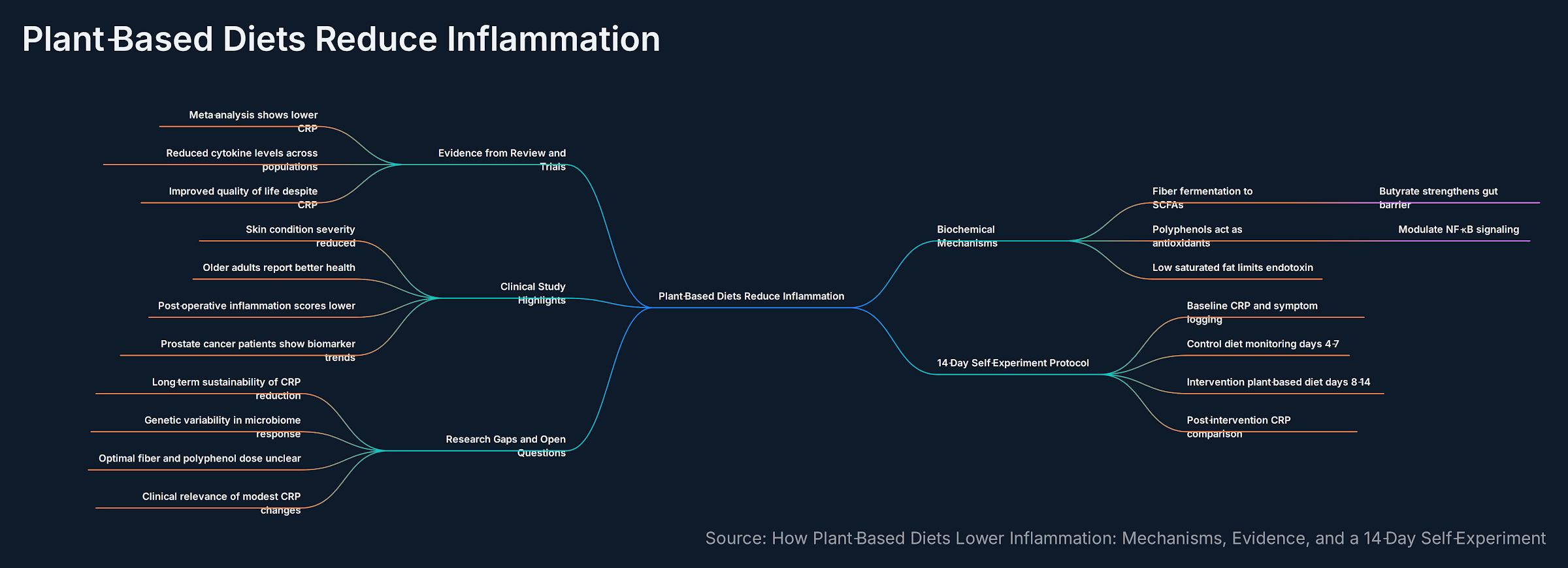
A new review of anti‑inflammatory diets shows that plant‑forward eating patterns consistently reduce biomarkers such as C‑reactive protein (CRP) and cytokine levels across diverse populations Overview of anti‑inflammatory diets and their promising effects on non‑communicable diseases (2024). This finding frames a growing case for shifting dietary composition toward plants.

Why plant foods dampen inflammation
Several biochemical routes explain the anti‑inflammatory signal. First, dietary fiber is fermented by gut microbes into short‑chain fatty acids (SCFAs) such as butyrate, which reinforce intestinal barrier function and blunt toll‑like receptor activation (mechanism before magnitude). Second, polyphenols abundant in fruits, vegetables, legumes, and whole grains act as direct antioxidants and modulate NF‑κB signaling, a master regulator of pro‑inflammatory gene expression. Third, plant diets are low in saturated fatty acids that otherwise promote endotoxin translocation and macrophage activation. Together, these pathways shift the immune system toward a more regulated, less reactive state.
Connecting the research thread
Beyond the broad review, several focused studies illustrate converging outcomes:
- The Influence of a Plant‑Based Diet on Skin Health (2024) reported reduced severity scores in inflammatory skin conditions, linking dietary polyphenols to lowered local cytokine production.
- A healthful plant‑based diet is associated with higher health‑related quality of life among older adults independent of circulating CRP (2025) demonstrated that even when CRP levels did not change dramatically, participants reported better perceived health, suggesting downstream benefits of reduced sub‑clinical inflammation.
- Implications of a Plant‑Based Diet in the Surgical and Critically Ill Patient (2025) found lower post‑operative inflammatory scores in patients who received a plant‑rich peri‑operative nutrition plan, hinting at clinically relevant modulation of the acute phase response.
- Plant‑based dietary indices and quality of life in men with prostate cancer (2026) showed modest improvements in patient‑reported outcomes alongside reduced inflammatory biomarker trends.
14‑Day anti‑inflammatory plant‑based challenge (n‑of‑1 protocol)
We propose a short, self‑contained experiment that lets readers observe personal changes in inflammatory markers and subjective wellbeing.
- Baseline (Days 1‑3): Obtain a fasting CRP test (commercial labs or home kits). Record daily mood, sleep quality, and any joint or skin symptoms.
- Control window (Days 4‑7): Continue your usual diet while maintaining the same logging routine.
- Intervention window (Days 8‑14): Adopt a strictly plant‑based diet emphasizing whole fruits, vegetables, legumes, nuts, and whole grains. Exclude animal products, refined sugars, and processed oils. Aim for ≥30 g fiber per day.
- Post‑intervention (Day 15): Repeat the fasting CRP test and compare against baseline. Evaluate changes in symptom scores.
Statistical null hypothesis: Mean CRP change from baseline to Day 15 = 0 mg/L. With only one participant, visual inspection of the pre‑post difference and symptom trends provides the primary inference.
Open questions and research gaps
While observational cohorts and small trials consistently point to anti‑inflammatory effects, several uncertainties remain:
- Long‑term sustainability: Most studies span weeks to months; the durability of CRP reductions over years is unclear.
- Individual variability: Genetic polymorphisms in gut‑microbiome pathways may modulate SCFA production, influencing response magnitude.
- Dose‑response relationships: The optimal amount of fiber or polyphenol intake for maximal inflammation reduction has not been precisely defined.
- Clinical relevance: Whether modest CRP changes translate into reduced risk for chronic diseases requires larger, randomized trials.
Readers are encouraged to log their observations and, where feasible, share de‑identified data with the longevity community to help build a collective evidence base.
References
- Mugo Moses H. (2025). The Effect of Plant-Based Diets on Insulin Sensitivity in Prediabetic Adults. RESEARCH INVENTION JOURNAL OF PUBLIC HEALTH AND PHARMACY. https://doi.org/10.59298/rijpp/2025/413841
- Xiao-Ping Yu, Haomou Pu, M. Voss (2024). Overview of anti-inflammatory diets and their promising effects on non-communicable diseases. British Journal of Nutrition. https://doi.org/10.1017/S0007114524001405
- Mildred Min, A. Tarmaster, A. Bodemer (2024). The Influence of a Plant-Based Diet on Skin Health: Inflammatory Skin Diseases, Skin Healing, and Plant-Based Sources of Micro- and Macro-Nutrients. Life. https://doi.org/10.3390/life14111439
- K. Schorr, M. Beekman, V. Agayn (2025). A healthful plant-based diet is associated with higher health-related quality of life among older adults independent of circulating CRP: a cross-sectional analysis from the Lifelines Cohort Study. Journal of Nutritional Science. https://doi.org/10.1017/jns.2025.10023
- Brody A. Smith, Thomas Herron, Sandra M. Farach (2025). Implications of a Plant-Based Diet in the Surgical and Critically Ill Patient. Current Surgery Reports. https://doi.org/10.1007/s40137-025-00447-x
- S. Sandhu, Li Zhang, C. Langlais (2026). Plant-based dietary indices and quality of life in men with prostate cancer.. Journal of Clinical Oncology. https://doi.org/10.1200/jco.2026.44.7_suppl.356