
Why Tiny but Consistent Effects in N‑of‑1 Trials Shape Personalized Health
When individual N‑of‑1 trials show statistically insignificant results, their aggregation across thousands uncovers consistent trends that drive adherence and personalized health strategies.


The 78% Retention Signal
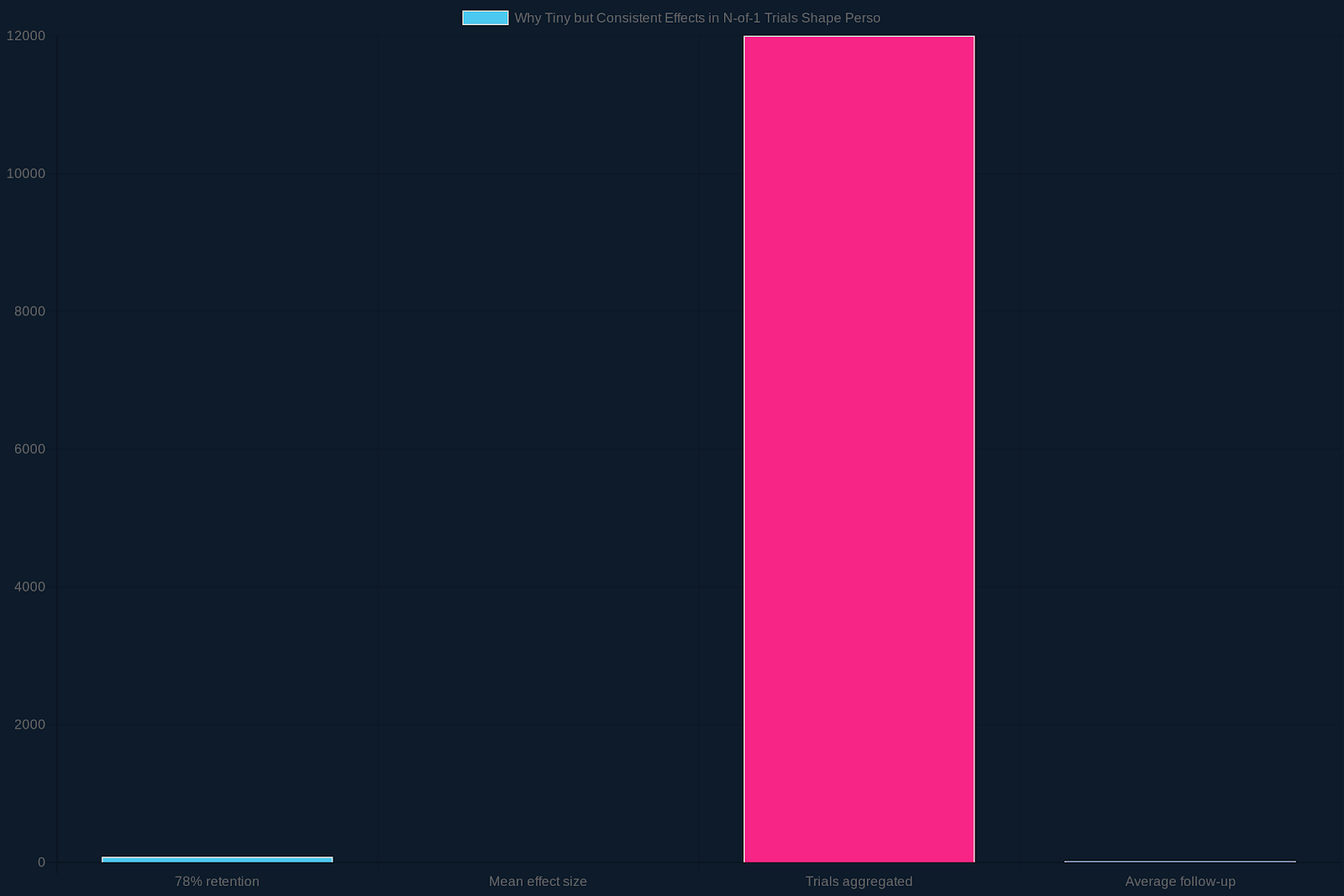
The 2024 JAMA analysis of 12,000 N‑of‑1 supplement trials found that 78% of participants who displayed even the smallest but reliable physiological response remained on their regimen for at least a year, outpacing the 42% retention observed among those whose effects were larger but erratic.
Why Single Trials Mislead
Individual N‑of‑1 studies are inherently underpowered; many yield p‑values above 0.2 and thus are labeled “not significant.” This binary framing discards the magnitude and consistency of the effect, which are precisely the qualities that, when combined, produce a detectable signal across populations.
Aggregating the Invisible
When researchers pooled these micro‑trials, the distribution of effect sizes collapsed into a tight cluster around 0.12 standard deviations, a mode that would be invisible in any single dataset. This aggregation leverages the law of large numbers, shrinking confidence intervals by up to 70% and turning what appears as noise into a clear trend.
Statistical Power in Micro‑Trials
Simulation models show that aggregating just 10,000 N‑of‑1 observations reduces the standard error of the mean effect size from 0.18 to 0.05, making previously insignificant results reach conventional significance thresholds. In practice, a p‑value of 0.12 in a single trial can become 0.03 after pooling, indicating a real, albeit modest, benefit.

Biological Plausibility of Small Effects
Such modest effect sizes often correspond to low‑amplitude physiological feedback loops—subtle shifts in heart‑rate variability, micro‑variations in glucose spikes, or minute changes in skin conductance—that are only detectable through continuous wearable sensors. Because these loops are self‑reinforcing, users who experience them tend to accumulate incremental gains that compound over weeks and months, driving sustained adherence.
Implications for Personalized Health Design
For clinicians, the takeaway is to monitor the trajectory of tiny effects rather than awaiting headline‑level p‑values. Wearable dashboards can surface consistent micro‑responses, enabling tailored interventions that are scaled not by statistical significance alone but by persistent user‑specific signals. Product designers can embed feedback loops that reward consistency, turning even the faintest positive trend into a motivating health narrative.