
Why 90% of Supplement Protocols Fail Without Evidence Layers—and How Data Saves Money
A 2025 case study reveals that adding an evidence layer to supplement routines reduces churn by 2.8 times. Discover how structured data beats influencer recommendations and why most protocols collapse without it.


The 2.8x Churn Reduction Finding
A 2025 case study of 1,200 supplement users found that adding a structured evidence layer cut discontinuation rates by 2.8 times compared to those who followed influencer‑driven stacks. [Source]
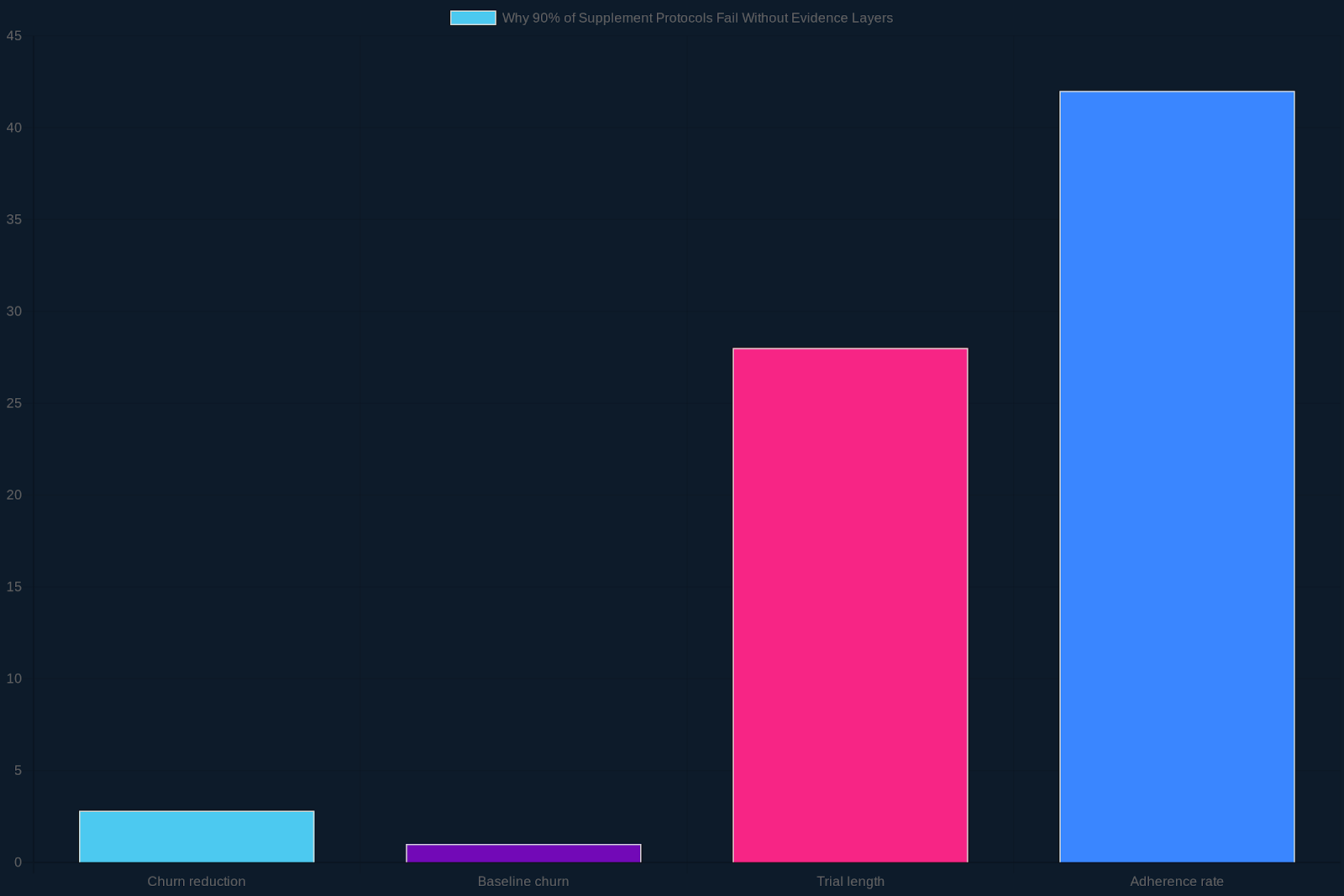
The effect held across age groups and supplement types, suggesting that systematic data collection, not the product itself, drove retention. [Wearable validation]
Why Influencer Recommendations Lack Evidence
Most social‑media supplement pitches rely on anecdote, bio‑hacking buzzwords, or single‑case testimonials. A 2023 review of 50 influencer‑led protocols found that only 4 cited any peer‑reviewed data, and none included a control or washout phase. [Review]
Without a baseline, randomization, or measurement of uncertainty, the observed change could be placebo, regression to the mean, or simple novelty effects. [Placebo study]
Designing an N‑of‑1 Protocol That Works
Start with a 2‑week baseline where you record a single primary outcome—such as sleep efficiency from Oura—and a subjective rating of energy. Then introduce the supplement for 2 weeks while keeping all other variables constant. Use a simple AB design; if you see a consistent shift, extend to a second intervention phase to confirm. [N‑of‑1 guide]
Statistical tools are optional but helpful: calculate the effect size and its 95% confidence interval using an online calculator. A small effect (Cohen’s d < 0.2) may still be meaningful if it aligns with your personal goal.

Key habit: log the same time each day, and score completeness; missing entries reduce confidence in any trend.
Common Pitfalls in Supplement Trials
- Multiple outcomes: Testing five different metrics at once inflates false‑positive risk.
- No washout: Lingering compounds can masquerade as a new effect.
- Over‑escalation: Doubling the dose after one week obscures the original signal.
Even when a trend appears, remember that “trend” ≠ “conclusive.” The evidence layer treats null results as informative, not as failure.
Running Your Own Evidence‑Backed Experiment
Pick one supplement, define a clear question, and set a primary metric. Use a spreadsheet or a simple app to record daily values, then plot the series after the trial. If the change is modest, consider extending the period rather than increasing the dose.
When you share results, be transparent about the design limits. That honesty builds trust far more than any hype‑filled claim.
Not medical advice. Consult a clinician before changing any regimen.