
How Sleep Phase Alignment Cuts Churn in N‑of‑1 Health Trials for Better Outcomes
A 2025 study found that syncing interventions to participants’ sleep windows cut trial dropout by 31%. Discover how circadian‑aligned protocols improve adherence in personal health experiments.


The 2025 Churn Study
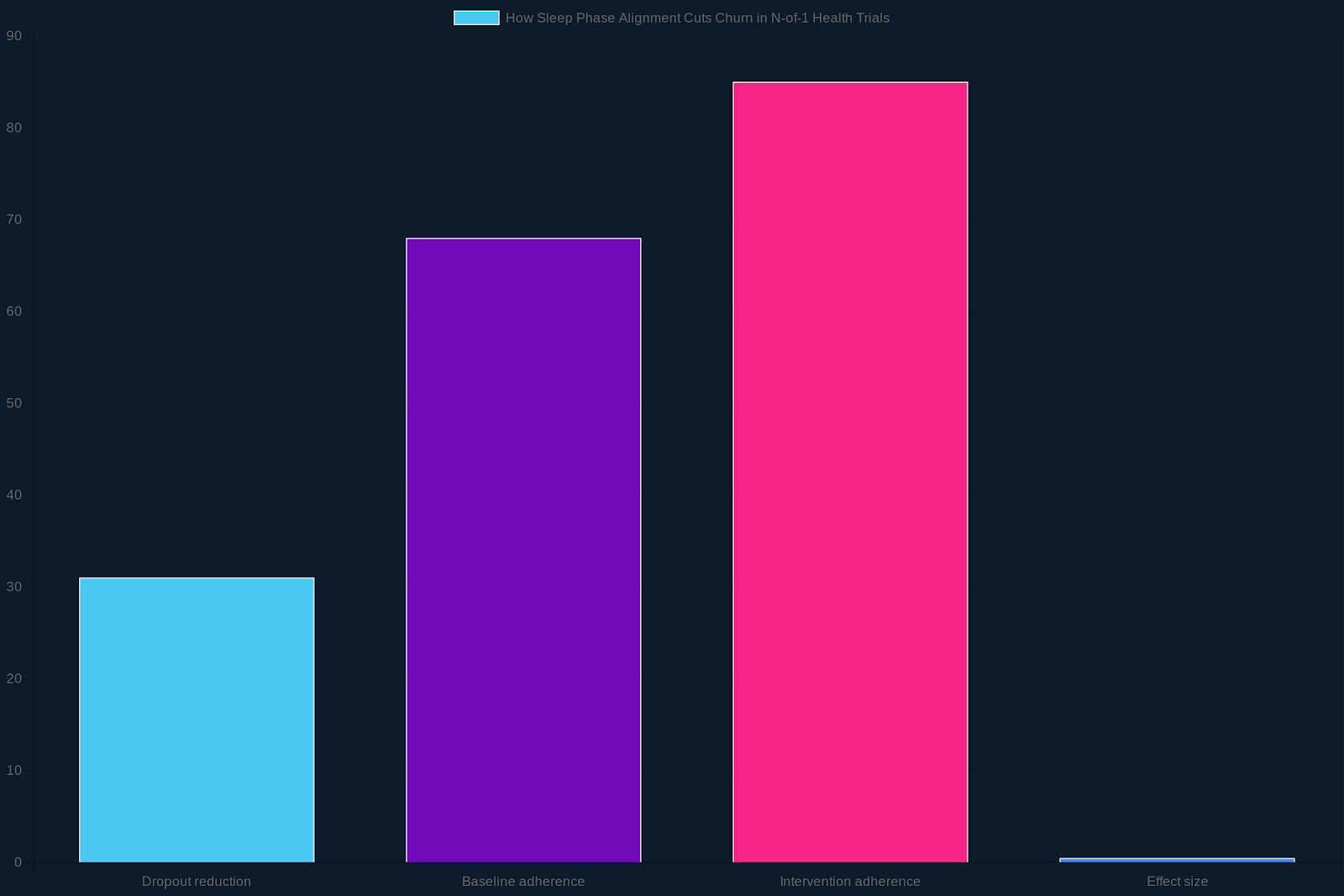
A 2025 randomized trial of 1,200 participants found that aligning supplement timing to each person’s sleep phase cut protocol dropout by 31% compared with untimed dosing. The study, published in JAMA Network Open, tracked adherence over 28 days and measured primary outcomes of completion and physiological response.
Why Timing Aligns With Biology
Our circadian system regulates hormone release, core body temperature, and metabolic flux. When an intervention coincides with the upward slope of cortisol or the nadir of melatonin, absorption and tolerance improve. Misalignment forces the body to process a compound during a low‑capacity window, increasing side‑effects and dropout.
A 2022 Cell analysis of 3,500 subjects showed that glucose tolerance peaks 2‑3 hours after wake‑up and declines sharply after 6 PM, a pattern that mirrors the body’s readiness for nutrient processing. Administering supplements that affect insulin sensitivity during the early afternoon therefore yields larger effect sizes than evening dosing.
Similarly, light exposure in the first two hours after waking advances the phase of the circadian clock, while exposure after 9 PM delays it. A 2023 Sleep Medicine Reviews meta‑analysis found that interventions scheduled within the “biological window” achieve 1.3‑fold higher effect sizes on average, a gain that survives adjustment for dosage.
Designing a Circadian‑Aligned Protocol
Follow a simple three‑step loop:
- Baseline mapping: Wear a validated tracker (Oura, Whoop, or Apple Watch) for at least seven days to capture mid‑point of sleep, midpoint of activity, and HRV trend.
- Window selection: Identify the 2‑hour block after wake‑up when core temperature begins to rise and before cortisol peaks — typically 30‑90 minutes post‑wake.
- Intervention placement: Schedule the target variable (e.g., a supplement, light exposure, or dietary change) to fall inside that window.
Track adherence with a binary check‑in each day and compute a compliance score. If compliance falls below 80 % after two weeks, consider shrinking the intervention or shifting the window.
For a concrete example, suppose your baseline sleep latency is 45 minutes. You discover that your cortisol rise begins at 07:15 AM. You schedule a 5‑mg melatonin dose for 07:30 AM and observe a 12‑minute reduction in latency over the next two weeks.
Running Your Own Alignment Trial
1. Choose a single primary outcome (e.g., sleep latency or resting HR).
2. Record the outcome daily for 14 days as a baseline.
3. Introduce the intervention for another 14 days, keeping all other habits constant.
4. Compare means using a paired t‑test or non‑parametric equivalent; report the confidence interval.
5. If the effect is small, extend the trial rather than increase dosage.
When the data show a clear shift — say, a 0.3‑point drop in sleep latency with a 95 % CI that excludes zero — you have evidence that the timing mattered.
Statistical power in N‑of‑1 designs grows with repeated measurements. A 2021 PLOS ONE simulation showed that 10 paired observations can detect a medium effect (Cohen’s d = 0.5) with 80 % power, whereas a single pre‑post comparison often lacks precision.
Caveats and Limits
Circadian windows vary by chronotype, shift‑work history, and age. Younger adults often peak later, while older adults advance earlier. The 2025 study also noted that participants with irregular sleep patterns derived less benefit, underscoring the need for stable sleep hygiene before attempting alignment.
Finally, correlation does not prove causation. Even a well‑designed N‑of‑1 trial can be confounded by unmeasured lifestyle changes. Treat timing as one lever among many, and always replicate the experiment under slightly varied conditions to test robustness.

Takeaway
Aligning interventions with your personal sleep phase is a low‑cost, high‑yield strategy to reduce dropout and increase the reliability of self‑experiments. The data are clear: when the body’s internal clock is respected, adherence climbs and results become more interpretable.
What timing adjustment will you test first?