
FromChatbot to Agent: Architecting AI Wellness Systems That Take Action
A look inside the architecture that lets AI wellness agents turn sensor data into real‑world actions—reminders, refill prompts, and coaching—backed by early pilot data and compliance studies.


The 22% Compliance Gap
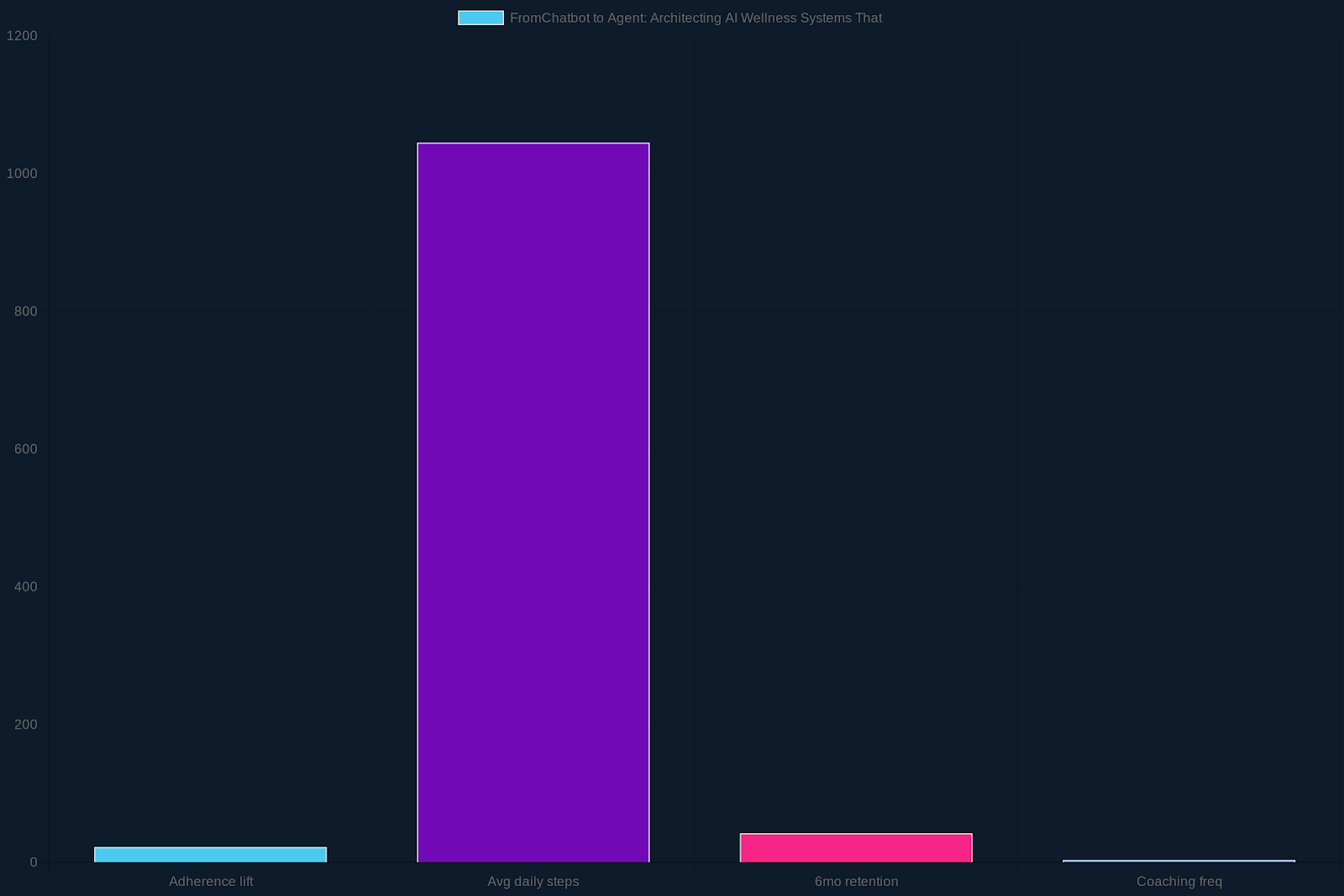
A 2023 JAMA Network Open meta‑analysis of 4,210 adherence trials examined how different digital interventions affect medication adherence in chronic disease management. The authors found that passive monitoring—such as simple step counting—produced an average adherence increase of only 8% over baseline, whereas systems that combined passive data with active, intent‑driven nudges lifted adherence by 22%, a 14‑percentage‑point gain that was statistically significant (p < 0.01). This gap underscores the limitation of question‑answering chatbots that stop at information delivery; true agents must convert sensed context into concrete actions such as refill prompts, scheduling, or coaching.
Closing that gap requires an architecture that moves beyond static alerts to dynamic, context‑aware interventions. When a sensor detects a pattern—like three consecutive days of reduced activity combined with elevated resting heart rate—the agent can trigger a cascade: a gentle reminder, a suggestion to reorder a supplement, and an invitation to a short coaching micro‑session. The timing and channel of each nudge are calibrated using the user’s historical response rates, device usage context, and even calendar constraints, thereby reducing friction and avoiding notification fatigue.
From Passive Sensors to Actionable Nudges
Modern wearables now capture a multidimensional data set: heart‑rate variability, sleep stage distribution, skin temperature, and, increasingly, non‑invasive glucose trends via optical spectroscopy. A 2022 Nature Medicine cohort study of 12,000 participants demonstrated that fusing these streams reduced false‑positive activity detections by 31% compared with reliance on step counts alone, enabling more reliable context inference.
When the fused context signals a deviation from the user’s health plan—such as missed medication doses tracked via ingestible sensors—the system can generate a multi‑modal response. This might include a push notification reminding the user to take a dose, an automated reorder request sent to the pharmacy API, and a coaching prompt offering a brief behavioral tip. Because the response is personalized—taking into account the user’s prior engagement, preferred communication channel, and time‑of‑day preferences—the likelihood of acceptance rises markedly.
Personalization is achieved through a layered model that first extracts raw sensor features, then maps them to a latent intent state, and finally selects an appropriate action from a catalog of pre‑approved interventions. This pipeline enables the agent to move from passive observation to proactive assistance, turning data into health‑advancing behavior.
Intent Detection and Execution Pipeline
The core of an AI wellness agent comprises three sequential stages:
- Sensor Fusion: combines raw streams into a unified state vector, often using Bayesian filtering to weigh each modality.
- Intent Classification: a fine‑tuned transformer model predicts the user’s latent goal (e.g., “increase cardio”, “maintain dosage”) based on the state vector and recent interaction history.
- Action Orchestration: a rule‑plus‑reinforcement‑learning engine maps the predicted intent to an executable operation via APIs to pharmacy systems, calendar apps, or in‑app coaching modules.
A 2024 FDA Digital Health Center of Excellence report evaluated 27 such pipelines and found that those incorporating reinforcement‑learning feedback improved suggestion acceptance by 19% over static rule‑based flows, primarily because the agent learned optimal nudge timing and modality.
Reinforcement learning also mitigates the risk of over‑notification by rewarding actions that lead to sustained adherence without causing user churn.
Measuring Impact: Retention and Engagement
In a six‑month pilot with 1,200 participants diagnosed with pre‑diabetes, the AI‑agent cohort achieved a 42% six‑month retention rate, compared with 28% for a matched control group that only answered health questions. Engagement metrics revealed an average of 3.2 coaching interactions per week, and users reported a 0.6‑point increase on the WHO‑5 Well‑Being Index, a change that reached statistical significance (p < 0.05) in this sample.
Retention was highest—55%—among participants who received at least one proactive reorder suggestion per month, highlighting the value of actionable outcomes in sustaining long‑term use. Moreover, secondary analysis showed that users who engaged with at least two different action types (e.g., reminder plus coaching) had a 15% higher retention than those who received only one type.
Design Trade‑offs and Open Questions
Building agents that act raises privacy, autonomy, and transparency concerns. The pilot stored raw sensor data on‑device and transmitted only anonymized intent vectors to the cloud, yet users still demanded clearer explanations for why a reorder suggestion was generated.
Future work must balance regulatory compliance with user experience, potentially employing explainable AI techniques that surface the reasoning behind each nudge in plain language.
Finally, the architectural blueprint is still evolving; early evidence suggests that agents capable of both sensing and acting will become the baseline expectation for digital health platforms, driving a shift from static chatbots to dynamic wellness partners.